


[Activity Report] HGPI Participates in Dialogue to Develop “Five Recommendations to Protect Communities from a Changing Climate” (April 9, 2026)
date : 5/1/2026
Tags: Planetary Health

![[Activity Report] HGPI Participates in Dialogue to Develop “Five Recommendations to Protect Communities from a Changing Climate” (April 9, 2026)](https://hgpi.org/en/wp-content/uploads/sites/2/lecture-media-369-top.png)
Health and Global Policy Institute (HGPI) participated in the “Knowledge-to-Action Dialogue” hosted by Health Care Without Harm (HCWH) and contributed to the development of the policy brief “Five recommendations to protect communities from a changing climate,” published on April 9, 2026.
In November 2025, HGPI signed a Memorandum of Understanding (MOU) with HCWH Southeast Asia, formalizing our role as an affiliate of the Global Green and Healthy Hospitals (GGHH) network. Through this partnership, HGPI is advancing integrated climate and health initiatives in Japan. Mr. Joji Sugawara, Vice Executive Director of HGPI, participated in this dialogue, providing Japanese perspectives to the formation of these international policy recommendations.
[Background and Overview of the Dialogue]
The policy brief was developed based on five key indicators from the 2025 Report of the Lancet Countdown on Health and Climate Change. The dialogue brought together 30 health professionals from 21 organizations worldwide, who engaged in comprehensive discussions on concrete policy actions that national and subnational governments should prioritize. Participants shared the recognition that climate change is no longer a distant environmental concern, but a present and escalating health emergency requiring immediate action.
■Five Policy Recommendations
The brief presents the following five priority policy actions:
- Mandate and Fund Climate-Health Vulnerability Assessments with Cross-Sector Collaboration
Establish legal requirements for regular climate-health vulnerability and adaptation assessments at national and subnational levels, ensure cross-sector collaboration, appoint dedicated climate and health officers within health ministries, and secure stable funding for implementation.
- Move from High-Level Policy to Practical, Multi-Stakeholder Emergency Readiness
Strengthen early warning systems, hospital resilience, and surge capacity planning for climate-related health emergencies such as heatwaves, floods, and wildfires, translating policy commitments into actionable, operational emergency response frameworks.
- Institutionalize Climate and Health Education Across Professional Training
Embed climate change and health as core required competencies in basic and continuing education for medical, nursing, and allied health professionals, promoting co-designed curricula with students as active partners in curriculum development.
- Elevate Health-Led Clean Air Advocacy Through Research, Forums, and Community Engagement
Expand locally-led research, establish national health-led clean air forums, and utilize storytelling and strategic communication to advance the transition from fossil fuels to clean energy as a health-protective measure.
- Embed Healthcare Sector Decarbonization into Health Economics, Standards, and Accountability Systems
Drive whole-system healthcare decarbonization through science-based targets, sustainable procurement, and waste reduction, integrating these efforts into health economics, regulatory frameworks, and quality and accreditation standards.
Implications for Japan
These recommendations provide important insights for addressing Japan’s key challenges, including rising heat-related mortality, the disease burden from air pollution, and healthcare system vulnerabilities to climate change. The cross-cutting principles of institutionalization, economic and fiscal framing, context-specific localization, and multi-stakeholder collaboration offer highly applicable perspectives for Japan’s policy development.
For the full report, please visit:
HCWH “Five recommendations to protect communities from a changing climate” Official Page
Related Posts
-
2026-01-16
[Announcement] HCWH SEA and HGPI Sign Memorandum of Understanding (MOU) to Advance Climate-Resilient and Sustainable Healthcare (November 24, 2025)
-
2025-11-11
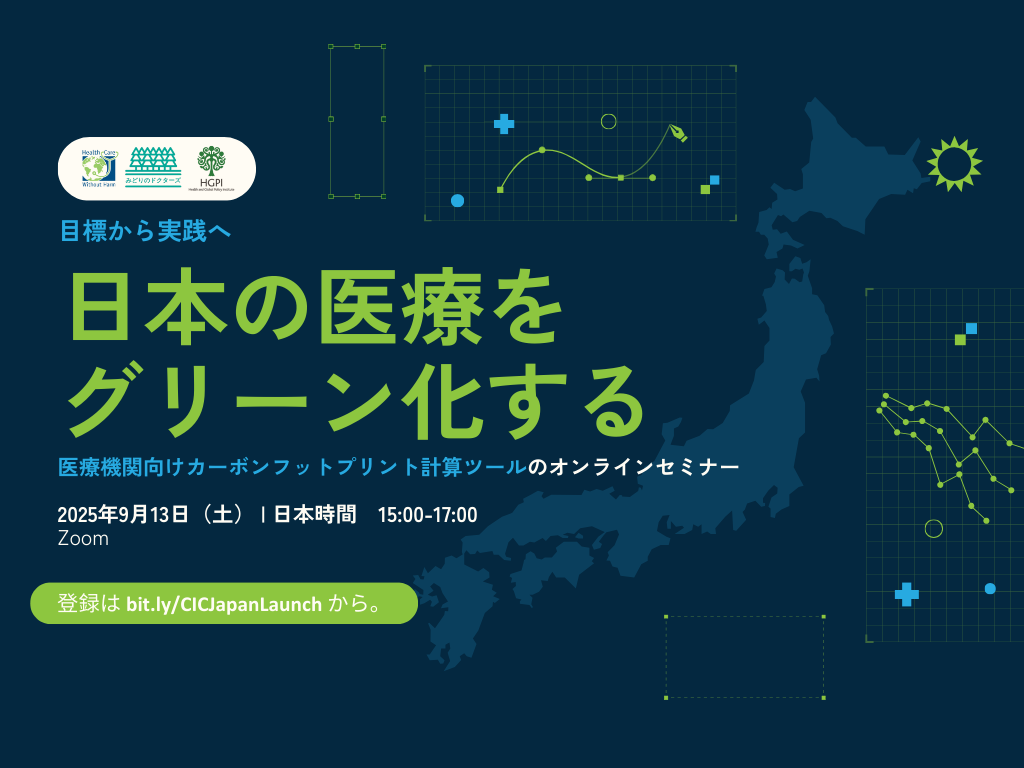
[Event Report] From Vision to Action: Greening Japan’s Healthcare “Online Seminar: Climate and Health 101” (September 13, 2025)
-
2026-04-15
[HGPI Policy Column] (No.70) — From the Planetary Health Project “Part 17: The Lancet Countdown: A ‘Lifeline’ for Health and Economy Brought about by Climate Action”
Top Research & Recommendations Posts
- [Research Report] Energy Conservation and Greenhouse Gas Emissions Reduction in Healthcare Facilities: Case Studies from New Construction and Facility Renewal (March 16, 2026)
- [Research Report] Perceptions, Knowledge, Actions and Perspectives of Healthcare Organizations in Japan in Relation to Climate Change and Health: A Cross-Sectional Study (November 13, 2025)
- [Public Comment Submission] “The 7th Science, Technology and Innovation Basic Plan” (Draft) (February 19, 2026)
- [Research Report] The 2026 Public Opinion Survey on Healthcare in Japan (February 13, 2026)
- [Policy Recommendations] Policy Recommendations in the Field of Blood Disorders “Building a Healthcare Ecosystem Centered on Patients and Those Affected” (April 13, 2026)
- [Research Report] The 2025 Public Opinion Survey on Healthcare in Japan (March 17, 2025)
- [Public Comment Submission] R&D and Social Implementation Plan for “Achieving Carbon Neutrality in the Waste and Resource Circulation” under the Green Innovation Fund Projects (Draft Revision) (March 25, 2026)
- [Policy Recommendations] Developing a National Health and Climate Strategy for Japan (June 26, 2024)
- [Policy Recommendations] Mental Health Project: Recommendations on Three Issues in the Area of Mental Health (July 4, 2025)
- [Research Report] AMR Policy Update #2: WHO’s First Report on Fungal Infection—Bridging the Gap Between Clinical Practice and R&D
![[Research Report] The 2026 Public Opinion Survey on Healthcare in Japan (February 13, 2026)](https://hgpi.org/en/wp-content/uploads/sites/2/HGPI_The2026PublicOpinionSurveyOnHealthcareInJapan_20260213.jpg)
![[Publication Report] Future of the Healthcare System Project “Policy roadmaps for acting early on NCDs” (March, 2026)](https://hgpi.org/en/wp-content/uploads/sites/2/HGPI_PHSSR-Report_20260421.png)
